A conversation with Thomas and his journey beyond comfort, into uncertainty and the wild
We’re bringing you a conversation with Thomas, a builder and explorer whose life has been shaped by curiosity, risk, and time spent far from the ordinary. From growing up in the UK to racing 900 km across Mongolia and walking alone in the Arctic, his story weaves together adventure, entrepreneurship, and a search for what really matters.
In this conversation, Thomas reflects on uncertainty, his entrepreneurship journey, and why time in nature, shared struggle, and capturing memories have become central to how he lives and builds. It’s an energising look at adventure, not as escape, but as a way back to ourselves!
For people getting to know you, how would you introduce yourself in one sentence?
I’m a builder and an explorer, I always liked to view myself as an adventurer who would head over the horizon have wild experiences and then come back successful with a bunch of great stories.
How did your relationship with adventure first take shape? You’ve said Mongolia was a big starting point, but were there smaller “mini-adventures” before that which hinted this was your path?
I grew up on the east coast of the UK, surrounded by fields and rivers, where adventure was part of everyday life. One of my earliest memories was spending a night on a small boat with my dad, and that sense of excitement stuck with me. There were lots of small moments too: sleeping out in snowy fields between Christmas and New Year just for fun, or spending hours crawling through woods and fields, convinced I was successfully hiding from fishermen and walkers who didn’t even know I was there.
So while Mongolia sounds like a big leap, it wasn’t completely out of the blue. Just three months after getting married, that same curiosity and appetite for the unknown took me there, where we ended up starting a business in a country we knew nothing about, in an industry I’d only spent around 14 months in.
While in Mongolia, you signed up for what you thought was a local race and ended up riding 900 km in 7 days. Were you actually ready for that challenge at the time? Any challenges that really stand out looking back?
Short answer: no, not even close.
I’d signed up thinking it was a small local race. Around the same time, an American ex-Marine had to leave Mongolia within 24 hours after a business deal went wrong and gave me his battered old metal bike rather than ship it home.
We’d just had a son, and if I’m honest, signing up was probably a reaction to that, a way of telling myself life wasn’t suddenly over. Only later did I realise the Mongolia Bike Challenge was 900 km in 7 days, with professional and elite athletes on the start line. And then there was me: no real mountain-biking experience, no physical preparation, and no idea how to prepare my kit.
I had one pair of shorts. By day two my skin was rubbed raw and bleeding, and a doctor had to bandage me every morning. It hurt like hell for the first 10 km each day, then you just carried on. I didn’t even consider mechanical failures, my chain snapped 10 km from the finish, which was pure luck. If it had happened earlier, I’d have been done. I ran the last 10 km carrying my bike.
The chain itself was a cheap knock-off, juddering and catching the entire 900 km. At times I was literally screaming at the sky. And yet, I loved it.
I loved it all, but when it ended I felt a real sense of loss. The final briefing finished, and just like that everyone went their own way. In many ways, those moments are when I feel most alive, and the pain of the ending is really the pain of returning to normal life. I probably need a therapist to unpack that, but out there, wherever that may be, is where I feel truly alive!
You spent around nine years in Asia and built companies there, building something from scratch is hard…and you did it twice. How did living and working across different countries shape the way you think about risk, comfort, and uncertainty?
Living in Asia completely changed how I think about risk. When you move between countries, languages, and legal systems, and try to build something from scratch, your perspective shifts. You stop seeing the world through the lens you were born into and start judging each place and situation on its own terms, weighing things up properly.
I used to say I just wanted a good story. After a few tough blows, my wife gets understandably annoyed when I say that now. These days, I’m trying to change the mantra to something healthier: I want a really successful, happy story.
For me, risk and uncertainty were the adventure. Without them, it doesn’t really feel like one.
This might not be directly related but, do you see a connection between your entrepreneurial mindset and how you approach adventure? I’m asking because, to me, both feel like stepping into uncertainty and figuring things out as you go.
For me, like entrepreneurship and adventure are the same thing. They're different in some ways, but also they're very similar. Both are about stepping into uncertainty without the clarity of what's around the corner, trusting you'll figure it out in the way. And if you're really passionate about the business you're doing, it feels similar to the passion I feel when I'm out in the wild - it's your stripping away the B.S. between you and the real world.
I’d love to talk about your adventure in the Arctic. How did you end up there, and what did that experience mean for you at that point in your life? Not many people can say they’ve been in the Artic!
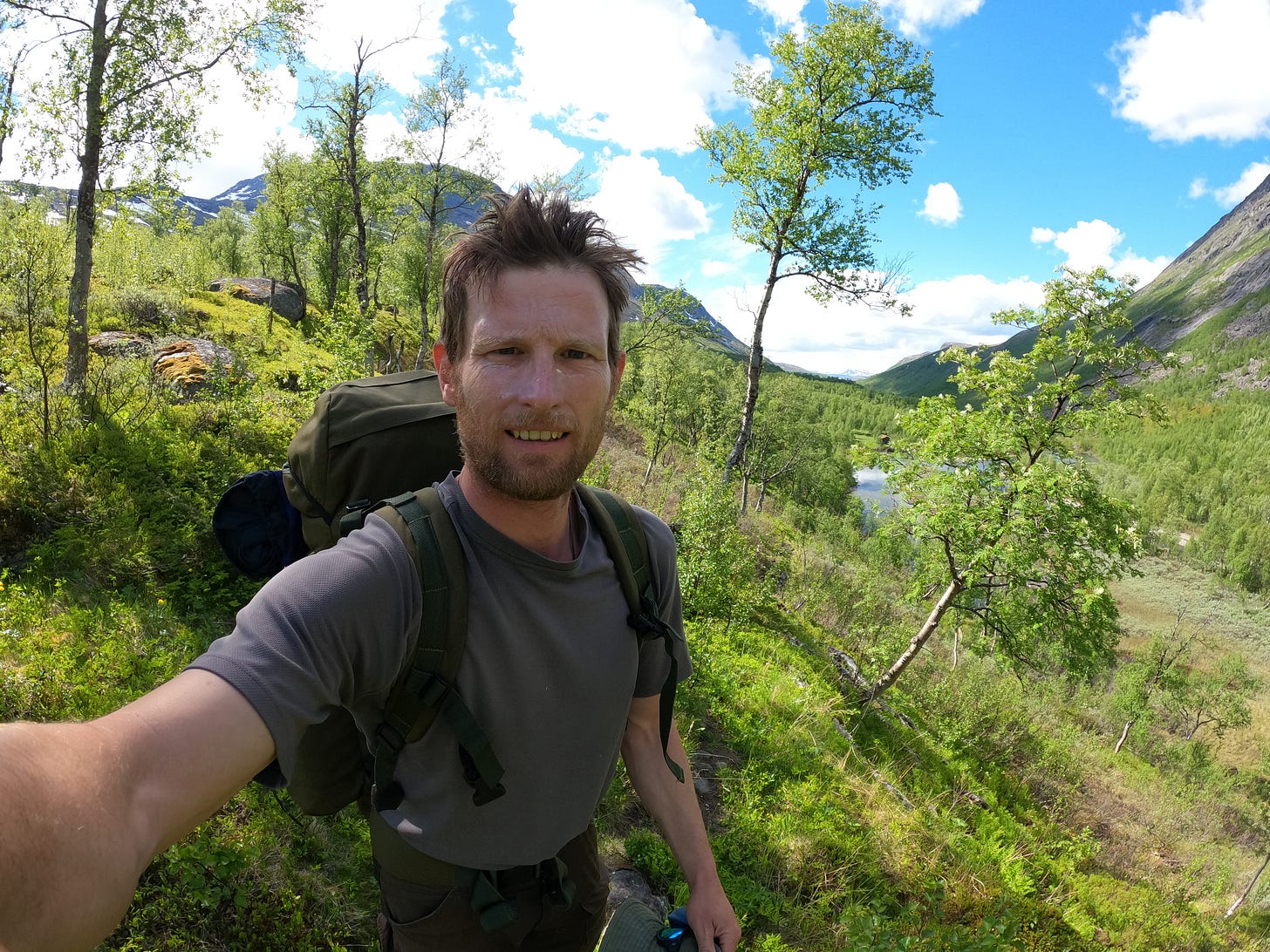
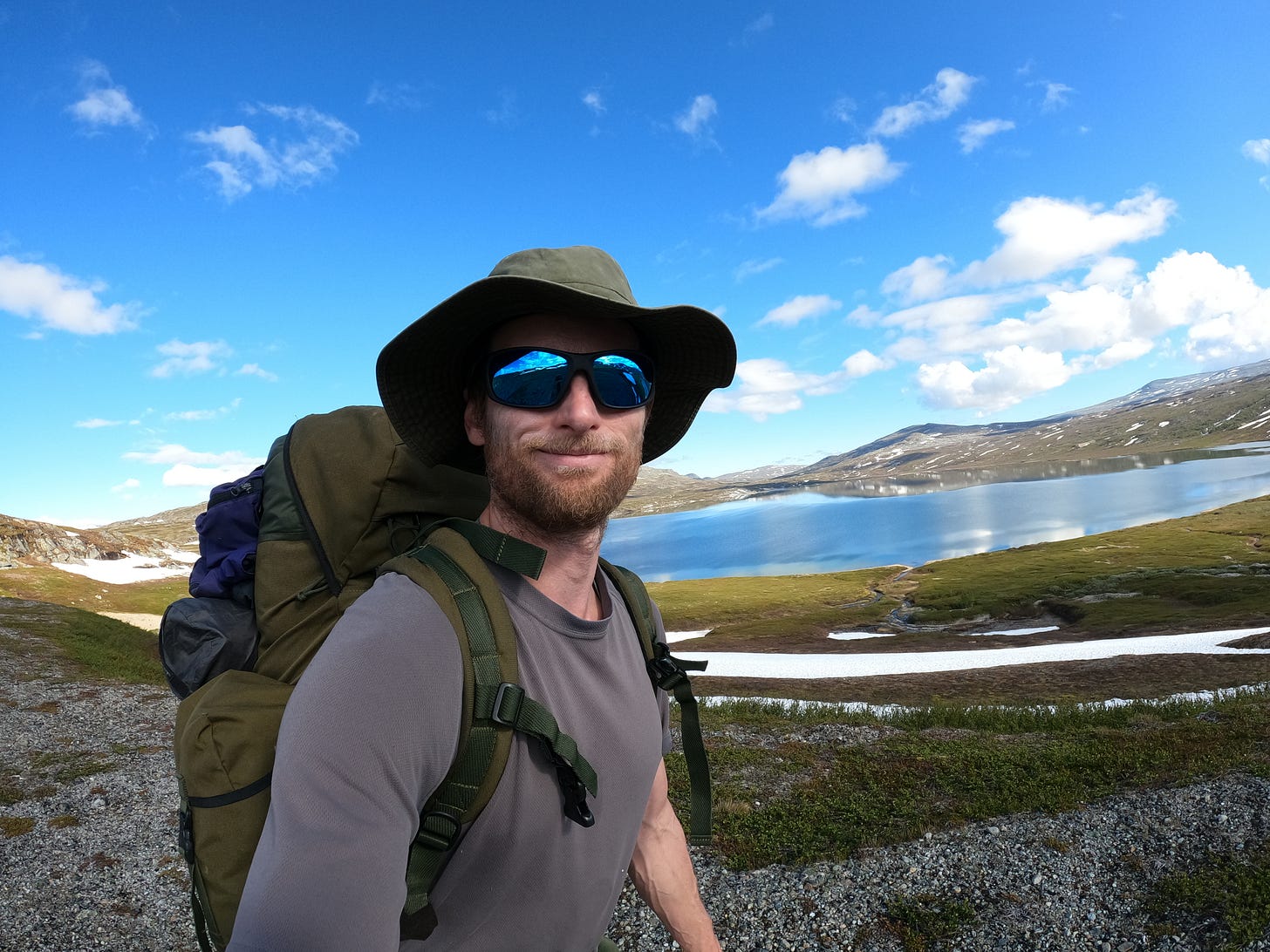
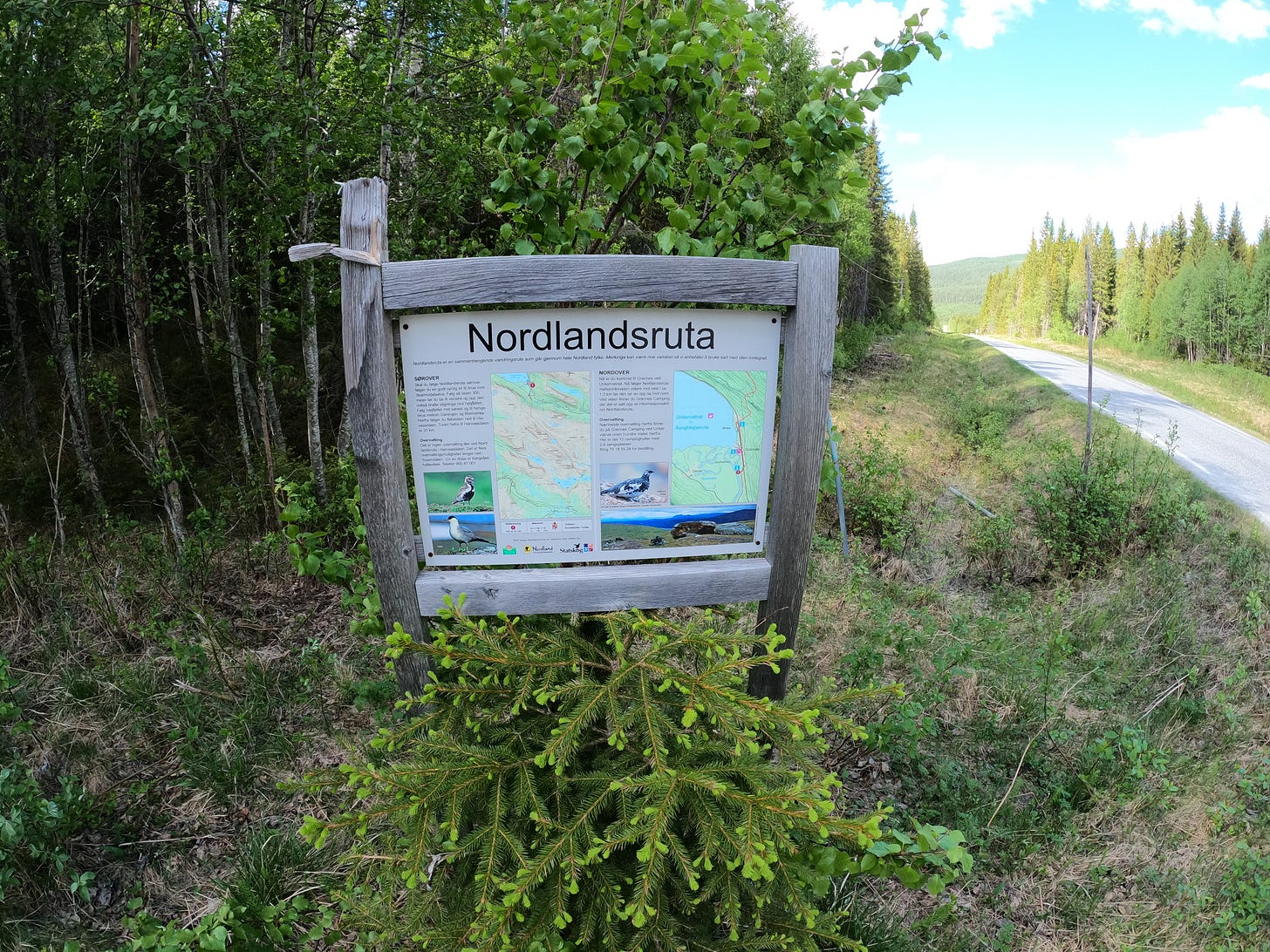
The Arctic happened because a couple of years ago, honestly, I got really low, I got really down, and my wife was pretty amazing and said, “Go do what makes you happy.” So I went out and spent a month hiking Nordslandruta up into the Arctic Circle. I chose that one specifically because I really didn’t want to see anyone. I didn’t want to be near people. I wanted to be in as much wilderness as possible. Northern Norway is well along with Northern Sweden and Finland about as remote as you can get in Europe. And I did it right at the start of the hiking season, much earlier than people recommend because that’s just when I could do it. But it meant that I really saw only a couple of people, two or three people on the trail in that whole month, which was just extraordinary and really gave me that silence, that space that I was looking for. What did it mean for me? It reminded me of what joy was. I have a memory of standing there, just walking up a valley, and the wind was biting. I stopped behind a little hillock, made myself a little soup, had the soup, and when I was standing up again, I was overwhelmed by this feeling of just happiness and joy. It was a feeling that I had not had for a long time before, and it was invigorating and gave me a sense of purpose and just happiness again that I had lost.
I was once told by a friend that zoo animals get antidepressants because they’re stuck in concrete boxes. And I think in a similar way, a large number of humans are stuck in concrete boxes and we drug ourselves with drugs, with social media, with distractions because we too are depressed in our concrete boxes. That’s one reason I think going into the wild feels so incredible because it feels like going home. Dad is our natural home. Concrete boxes are not.
On your website, you wrote about these memories that stay with you. Do those moments mostly live in your head, or do you capture them somehow, through photos, notes, or video?
I'm trying to get better at capturing memories. I have just lived a lot, but what I've realised with age is that those incredible experiences, unless you capture them and can be referred back to, just become vague fragments of memory. Years of my life I remember in vague fragments of memory, and that seems a shame. So I'm really trying to get better at capturing things with videos, voice notes, emails to my kids. We actually got an email address each, and over the years we've been sending them photos and thoughts as it comes up. Hopefully, it will be a way of them capturing a moment in time when they're much older.
What are your thoughts on the pressure today to document everything?
If it’s not on YouTube or Instagram, did it really happen? Haha. I think it’s the attention economy. I think, especially as AI comes along and takes away intelligence as the value commodity, I think attention is going to be more and more important. Some people are going to be able to be paid for documenting things, and it’s just going to become a new job for some people.
I guess it’s not worse than sitting at a desk grinding away doing the kind of work that people have done in the last 20 or so years?
You talk about longevity not as a trend, but as something deeply human. What does longevity mean to you personally?
Longevity means being as fit and capable as possible for as long as possible. Honestly, I’ve also had times where I’ve had very low periods, and I still was really interested in longevity. Not unreasonably, a friend asked me why you’re so interested in longevity if you’re not enjoying the now. It’s a bloody good question.
So, longevity is about doing and being able to do what I enjoy for as long as possible, and that longevity focus has to be, I have realised, built on a foundation of real focus on the here and now and the present.
You’ve now built a company called Type 2, and you describe Type 2 as the kind of “fun” that isn’t fun at the time but it becomes some of the best fun of your entire life. And, I totally agree! Would be great to learn more about this new adventure, is that what you’re mainly focused on for 2026, or are there bigger plans taking shape?
Type 2 fun for me is what I call the real world. It’s being in nature, it’s doing what humans were designed to do: to work, to physically strain, to struggle, and have discomfort. It’s what we are bred for on a genetic level, and it’s also what gives us our happiest memories. Yet modern life has been focused on convenience, and I don’t think that’s been as happy days in the show across populations.
What’s next? I want to live that Type 2 Fun lifestyle. I need to figure out how to enjoy my present and then we can look at how to figure out that formula. Then, if people are interested in helping that scale, and I think there is the need for there, looking at the depression rates and mental health rates, how we live life is not making us happy. And we are all, whether we like it or not, going to go through a massive change due to the AI revolution which is coming. It might be in one year, it might be in 10 years; it’s not really relevant. If you plan to live more than 10 years, it’s coming, and we need to figure out better ways to live. I think the only thing that will become valuable long-term is being human. And I feel Type 2 Fun and that, being in the wild and testing ourselves is at its core a deeply human experience.
If someone feels stuck and knows they want more from life, what’s one small, realistic step they could take to start an adventure?
I personally would say that if you feel stuck, the first thing is to seek help and get your friends and family around you. But the most impactful thing I did was to create distance, to get away and be by myself in nature.
For me, that meant the Arctic. For someone else, it could simply be walking the hills near their home. I think the critical factor is time: at least three days away from the stresses and strains of modern life, and crucially, being by yourself.
When you combine at least three days alone in nature, what I found was that the things that were really getting me down, or causing stress, slowly lost their emotional charge. I wasn’t topping them up. You don’t top them up when you’re on a mountainside and your brain is full of practical questions: which route should I take? Do I need to get my trousers on, or my gaiters? Have I fuelled myself properly?
There’s also a huge sense of satisfaction in simply getting through the miles. That space, and that different mental model, allowed me to look at my life without the negative energy, and to see it more objectively. I found that really, really helpful. It unstuck me and gave me a route forward.
It’s not perfect. It’s not a silver bullet. But it was the thing that got me unstuck.
The last section are just quick-fire, fun questions. First one, mountains or desert?
Mountains
Solo or shared adventure?
Both, but shared suffering creates bonds faster. I think solo or shared adventure is a tool, and you need to link it to your objective. If you’re looking for community and connection, then it’s obviously shared. If you want a mental break, or you’re trying to work through something, then solo time can be much more powerful.
Bike or boots?
Boots. Always boots. The Mongolia Bike Challenge was one of the most experienced in my life.
One place that keeps calling you back?
The north. Fewer people. European context, real wilderness.
Where can people find you and follow your work?
Type2.travel, and occasionally on Reddit LinkedIn or Twitter when I’m not outside.
And finally, what’s the most unforgettable moment you’ve ever captured on camera?
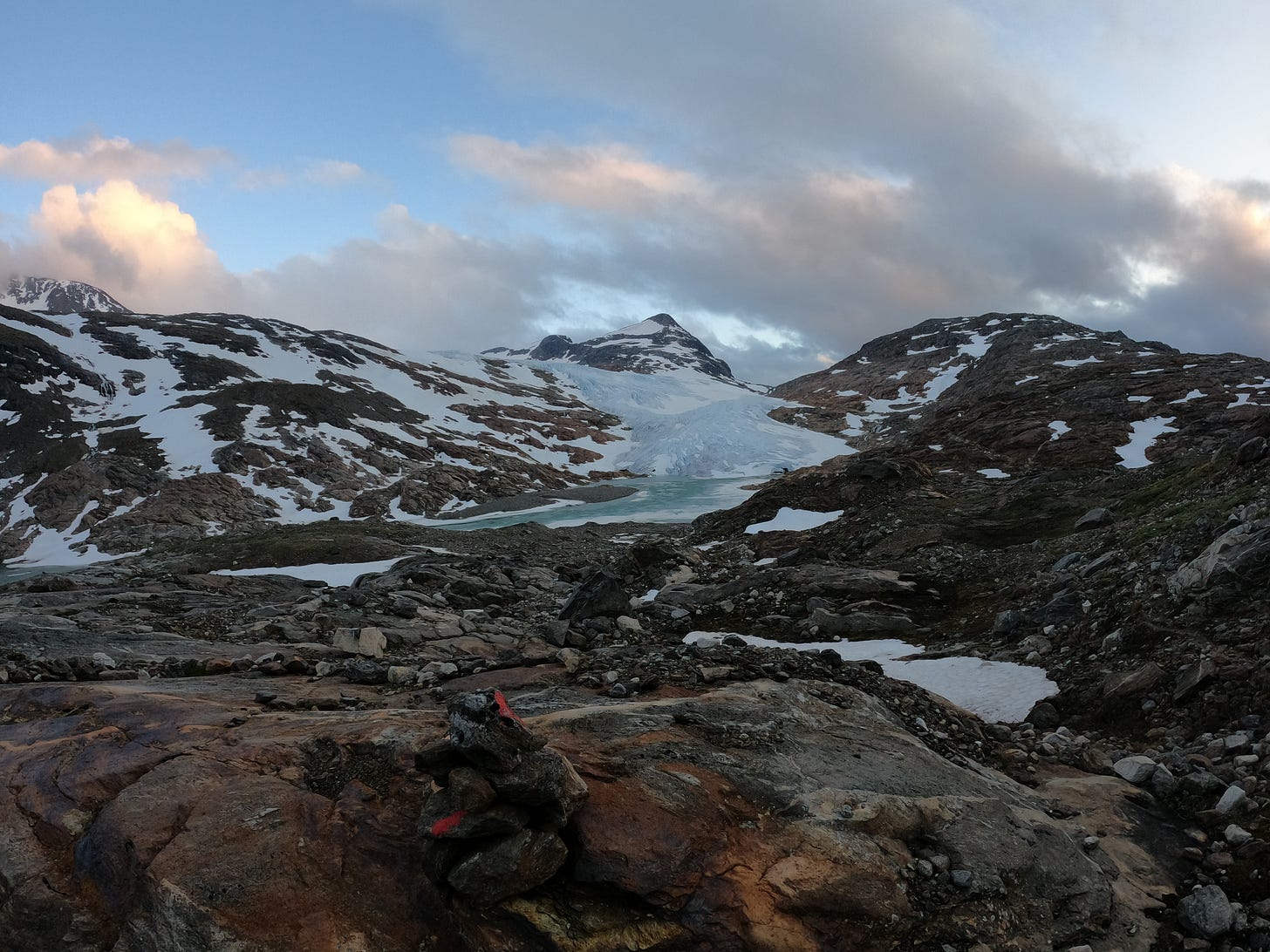
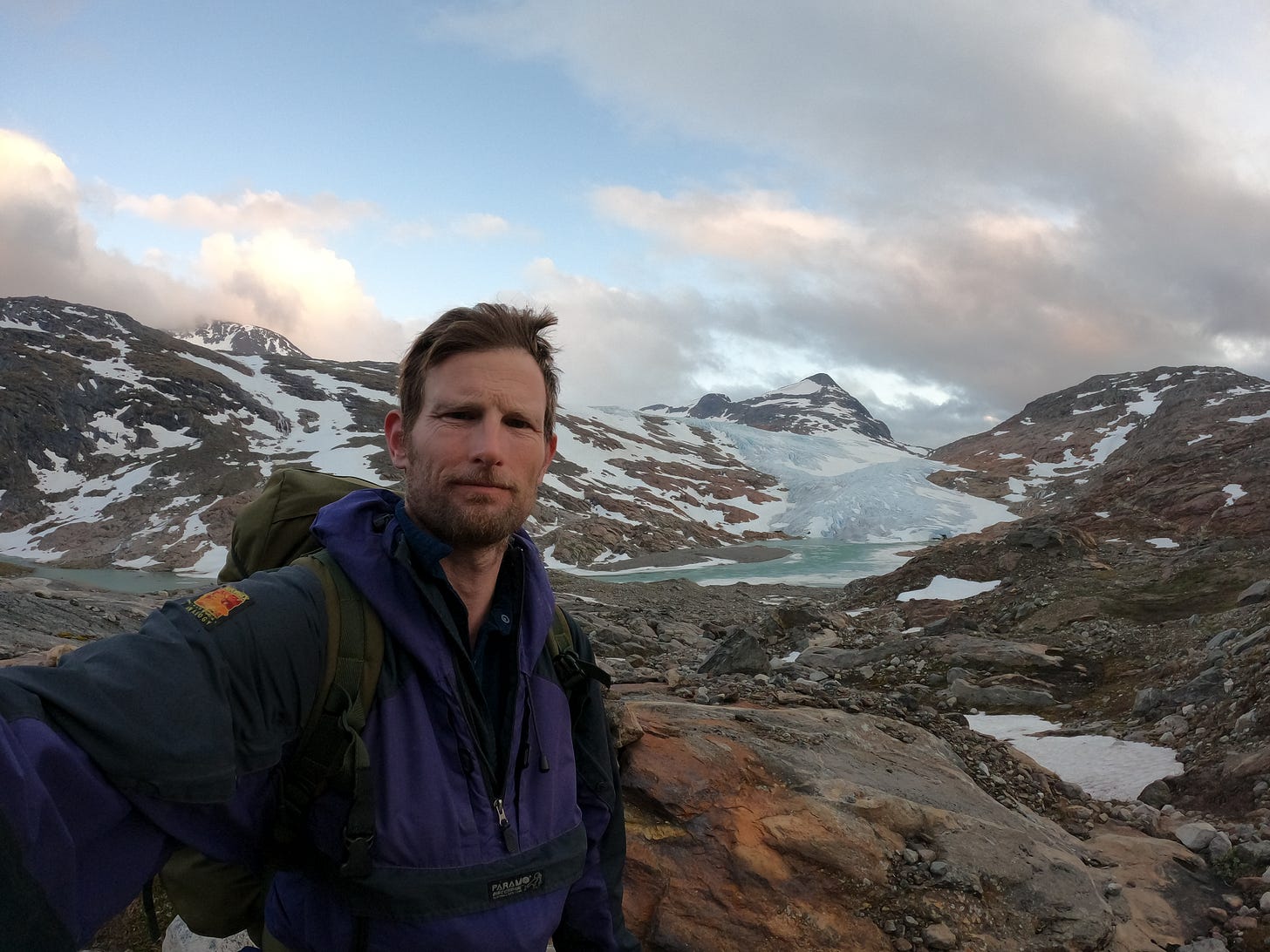
I was walking in Norway in June, up in the high north, and I didn't have an award on me. My purpose was to just go by my body clock, so I walked when I felt like it. That ended up with me walking completely alone around past the bottom of the glacier, and the light was extraordinary. That photo is a pale imitation of it, but they take me back to that moment, and it's one of the most extraordinary moments I've ever captured on camera.
A huge thank you to Thomas for sharing his journey with us. His story is a reminder of the power of uncertainty, time in the wild, and choosing the harder path when it matters. You can follow more of Thomas’s adventures and work at Type 2. Thanks again Thomas!